Lessons in Reading and Writing: Why Do Philosophy, and How to Do It
(Podcast available)
These essays were planned and written as a series. In them, I summarize some of my own practical lessons from doing philosophy. I have long kept thinking about one question: how can one create something new? My answer is now firmer than before: keep thinking continuously, at all times and in all places. I made this series in order to organize part of that idea and pass it on to those who might find it useful.
These essays are arguably the most valuable part of this site. They are for anyone who wants to study philosophy and engage in theoretical research in philosophy and the social sciences, and they are especially suitable for master’s and doctoral students.
The Scaffolding We Use Without Noticing
Open almost any work in philosophy or social science and you will see words everywhere such as: analysis, phenomenon, a priori, experience, concept, category, logic, essence, property, reality, norm, fact, hypothesis, verification, proof, truth, theory, practice, thought, self, and so on. Expressions like the following are extremely common:
- “We must try to analyze this phenomenon.”
- “This fact must be empirically observable, rather than a priori.”
- “Analyzing this concept helps us grasp the essence of the relevant thing.”
- “Theory should fit reality, and theory should be used in practice.”
- “This kind of thought and behavior is illogical.”
- “What we do is positive research, not normative research; we study how things actually are, not how they ought to be.”
I do not have time here to survey the literature carefully and provide many real examples, but these improvised examples should already feel familiar. We see others writing this way, and we do it too. Yet when asked questions such as what analysis is, what a concept is, how concept and experience are related, where the boundary between theory and practice lies, and so on, many of us, including those authors, no longer know how to answer. It is like our relation to time: at every waking moment we feel time passing, feel surrounded by time, use time to order events, use time to understand history and arrange the future. But when asked “what is time,” most people fall silent. Those concepts or categories we use are like time in this respect: for most people they remain in a state of daily use without explicit awareness.
This is somewhat embarrassing: we keep saying we must “analyze a phenomenon,” yet cannot clearly say what “analysis” is or what a “phenomenon” is. We can only roughly say which concrete acts count, in our usage, as “analysis,” and which observations count as “phenomenon.” The problem is this: if we do not know what “analysis” and “phenomenon” are, then how exactly are we calling what we do and obtain “analysis” and “phenomenon”?
I call these concepts the scaffolding of thought. In construction, scaffolding is what workers stand on and rely on while building a structure. Scaffolding is not part of the building itself; it serves construction. Likewise, the concepts above are used by us to think, speak, and act, but usually are not themselves part of the immediate content in view. Scaffolding is often assumed to be simple, unproblematic, and ready-to-hand relative to the building being constructed.
Whether in common sense or theoretical research, most people remain in what Heidegger called a state of “readiness-to-hand” (Zuhandenheit): when we hammer nails, our eyes are on the nails. Only when the hammer fails or breaks do we look at the hammer in our hand, stare at it, think about it, and try to repair or replace it. This is the state of “presence-at-hand” (Vorhandenheit): we begin to notice the hammer itself.
Clearly, in this case the hammer is in fact heavier and more complex than the nail. This is why when our thinking and practice run into problems with tools, we often face greater difficulty. Similarly, another obvious fact is that the one who thinks and acts may be far deeper and more complex than the world as object. Thought and action are acts issued by a subject, directed at the world. If we always stay in the ready-to-hand state, this unreflective stance makes us quite familiar with what receives force, while unfamiliar with what exerts force. It is like knowing the world we see quite well, yet knowing nothing about our own eyes. But if one day we are told that our eyes capture only a particular spectrum, or that what we see is only a projection of the world, we face a visual crisis. One lesson from Plato is precisely this: attend to the limits of the eye (mind) with which we observe the world - what we see may only be a projection.
What is a concept? What is the relation between concept and thing? What is conceptual reference? How is reference different from indication? If we keep asking such questions, are we going mad? If I do not study optics, can I not study painting? If I do not study physics, can I not read a clock? Of course not. But if you want to study these from a more general perspective, you need to revisit those tools that are used daily without awareness. For many non-theoretical fields, or even some areas of philosophy, the requirement here remains relatively loose. But for philosophy and social science research, this scaffolding is not merely auxiliary. It is the point from which the theoretical building is supported and constructed. If we know nothing about it, that is not harmless.
When you solemnly say you are going to “analyze a phenomenon,” yet cannot explain what analysis is or what phenomenon is, that too is not harmless.
Someone might say: this is a philosophical pathology. It pushes everything into a priori speculation or conceptual analysis, assumes no further thinking is possible until these basic concepts are fully clarified, and thereby loses the capacity to grasp reality in common sense and concrete context. As some people put it, “after learning some philosophy, one can no longer handle ordinary life.” Not everyone needs to speak like a philosopher about these matters in full detail; we may only need to know how to use them, not what they are.
This objection is indeed reasonable. In many domains of thought and practice, we can in fact use things in a state of ignorance. If a physicist writes in his native language, why must he first systematically study native grammar before beginning? We are quite fluent users of our native language. In general we follow correct grammar in speaking and writing, and we can criticize obvious grammatical violations by others. But not everyone needs to be a linguist and give a full systematic account of native grammar.
Fair enough. I accept this rebuttal. To recommend familiarity with the scaffolding of thought, I restrict the scope to those engaged in theory-building within philosophy and social science. In this scope - say jurisprudence or legal philosophy, criminal law, or procedural law - we always encounter a set of core concepts. Their most typical feature is that they do not have straightforward counterparts in the common-sense physical world. They are not object terms like “apple,” “car,” or “rice” with direct physical referents. They are theoretical terms like “right,” “justice,” “fact,” and “sincerity,” terms that seem to point toward mysterious realities deep in the universe or diffused around us; supposedly physical objects in our world instantiate or partake in those realities.
If you still do not understand the relation between abstract properties and concrete objects; if you remain unclear about the philosophical significance of the many terms ending in “-ness,” “-ity,” “-ization,” or “-capacity”; if you are not sensitive to the fact that in using such terms you are often committing yourself to abstract properties or realities - then you do need to revisit the scaffolding that supports you. If you try to connect the core vocabulary in your own field to more general understandings of world, self, mind, reason, cognition, and action, and to a basic picture of mind and world, then again you need to revisit your scaffolding. You cannot avoid this, because how you handle these matters eventually returns to how you understand yourself.
So far I have explained what I call the scaffolding of thought and why it matters. Whether you study this scaffolding largely determines whether you are doing philosophy. You may ask: “Even if this is philosophically important, why should I do philosophy?” I cannot fully prove the following claim here: if you have never studied this scaffolding of thought, then as a researcher in philosophy and social science, you may never truly enter the inner room of your own field. This is hard to prove directly; the best proof might be to display the best possible form of work in a field, which cannot be done here. If you grant this claim some credibility, the next question is: “How do I study this scaffolding?” We will return to this. This is only the beginning of the series.
Why Do Philosophy?
I want to limit the audience of this theme to theoretical researchers in philosophy and social science. I am talking about doing philosophy, not merely studying or reading philosophy. Doing philosophy means not only reading philosophical texts and learning concepts, views, and arguments from philosophers, but also trying to think and write about the same kinds of problems philosophers think and write about. In other words, doing philosophy means not merely being a philosophy enthusiast, learner, or consumer, but becoming a participant: reading, thinking, and writing on problems in the way philosophers do.
Before discussing how to do philosophy in concrete terms, one prior question is: why do philosophy at all? For many people in philosophy and social science, the following thought is typical:
My field does involve philosophy, but it is not philosophy itself. I only need to learn some philosophy and apply it in my own field. If I spend too much time learning philosophy instead of my own field, that is putting the cart before the horse, even a kind of unserious scholarship.
The key points are: (1) my field is not philosophy; (2) learn some philosophy; (3) apply philosophy to my field; (4) do not reverse means and ends.
All these points are reasonable and their force varies by field and direction of research. Yet I can still say that, in a general sense, these points are mistaken; and the closer one is to theoretical work, the more obvious the mistake becomes.
I cannot examine each point one by one. I assume my readers are interested in general theoretical inquiry. In law, the field I know best, this is clear: not only legal philosophy, but also criminal law, civil law, procedural law, and international law all contain pervasive and significant philosophical issues. Whatever the explicit goals and topics in these fields, we cannot avoid core concepts that are closely tied to philosophy, and we are constantly using scaffolding of thought to build theory.
In legal philosophy, thinkers such as Hart and Dworkin were not simply “applying” resources learned from philosophy to law. More accurately, they were philosophers in the strict sense, and law was simply one particular domain they happened to find compelling. Anyone doing legal philosophy must train as a philosopher, not merely as a consumer of philosophical ideas.
More generally, philosophy is not merely a profession or discipline. It is a mode of thought and a way of life: a kind of contemplative theoretical gaze. Standing on a crowded street, a person with philosophical sensibility cannot help asking many questions. One key question is: how does this society actually operate? Is it real? What is my place in this world? How do I know and understand the world and myself?
Once you care about such questions, you become aware at a basic level of the structure person-world, or mind-world.
On the one hand, only when you are sufficiently familiar with the subject that observes, perceives, understands, and even changes the world - the person or the mind - can you truly notice thought, ideas, and theory as such. They all issue from this side.
On the other hand, only when you understand that, whatever the world is like, it must first be grasped by persons or minds as certain ideas, then referred to through concepts, and expressed in language, can you see what is at stake. For example, even if one says the world is made of matter, one still needs to answer: how is this material world grasped by mind? You will no longer use labels like “idealism” and “materialism” in a numb, mechanical way.
In short: what the world is like; what the “person” or “mind” that grasps it is like; what the mediating layers between world and mind - ideas, concepts, language, meaning - are like. Only when such a basic dual-structure picture is present in thought can one, at least in my view, be called a genuine beginner in thinking.
If one has never carefully coordinated thought and speech with such a framework, and has never even noticed it, that is common yet still startling. Whatever your ultimate stance toward this framework, and whatever your concrete views about its details, if you want to become a thinker and a theorist, it is necessary not only to stare at the world, but also to care about the function of the eyes.
In thought and speech, the basic matter is simple: what objects are in the world, how our concepts grasp them, and what words express those concepts. Open philosophy and social science literature and read carefully, and you can judge an author’s intellectual quality - or philosophical cultivation - by how self-aware the author is about this mind-world dual structure. If you find that the author:
- has no basic mind-world framework at all, and simply assumes the world manifests itself directly without being conditioned by mind;
- fails to recognize the structure of thought and speech, namely: mind captures things in the world as ideas, concepts refer to those ideas, and language expresses concepts so as to point back to things;
- fails to recognize that ideas and concepts are mediators between mind and world;
- or fails to recognize that language, as expression of concept, is itself first an object in the world with a specific sound-form or graphic form, and does not magically carry “meaning” by itself,
then you can basically conclude that whatever the author says about essence, truth, concept, property, or reality is far from philosophy.
“I must do real theory well!” This sincere call can be realized only on the premise of doing philosophy.
You may still find this odd: why must it be tied to philosophy? But this is in fact true. Any theoretical work, in any level or field, aims to explain or understand some reality or state of affairs in world or mind. It is hard to imagine that someone who lacks even a basic mind-world framework in thought can say anything valuable about the world; such a person may not even know what “thinking” or “saying” is.
Generation after generation, scholars learn, research, and grow old this way. Most may spend a lifetime doing work they never seriously inspect. Whether professor, expert, or authority, they look almost only at the world and not at their own eyes; they focus on nails and ignore the hammer in hand. Perhaps the best epitaph for such a person is: “When he was alive, he was everything; when he is dead, he is nothing.”
They do not understand - or do not care - that any thought and speech about the world must include thought and speech about the act of thought and speech itself. One cannot neglect either the object of mind or the act of mind. Terms such as mind, world, object, concept, and word are repeatedly used; this may look philosophical on the surface, yet inwardly remain unrelated to philosophy. Such work makes itself worthless, because it has no qualification to speak about the world.
I know there are many scholars unwilling to spend life as apprentices repeating others. They genuinely want to think and speak about the world.
For such a person, avoiding a wasted life - avoiding becoming dust under the wheel of time - is a question to ask constantly. For such a person, whether or not one “does philosophy” in name, as long as one is doing theoretical work, even merely as a speaking and thinking being dwelling in the world, having a basic philosophical mind and a certain level of self-awareness about that framework is necessary.
And to do philosophy, one must have one’s own coherent understanding of the meaning of almost every single word in claims such as: “mind captures things in the world as ideas, concepts refer to those ideas, and language expresses concepts so as to point to things in the world.” Is this too strict? Not for doing philosophy. Has anyone achieved this? Of course - many have.
Do Philosophy, Not Just Study Philosophy
In the previous two essays I discussed two issues:
First, the scaffolding by which we build our house of thought - basic concepts and categories - remains, for us, in a daily-used-but-unnoticed state. If we do not seriously revisit and study this scaffolding that we stand on and rely on when building theory, it is hard to enter the inner room of any theoretical inquiry.
Second, if we are not specialists in philosophy, how should we study this scaffolding, and to what degree is enough?
The shortest answer to the second question is: do philosophy. Then what is doing philosophy? How is it different from reading or studying philosophy?
I had many deep conversations with a friend from a philosophy department. I could see he loved philosophy and worked hard. But I was surprised to find that he rarely wrote his own pieces, except papers he had to publish. In our exchanges, the pattern was often this: I would keep presenting my recent thoughts at length, while he would seldom state his own. I could speak continuously for four or five hours about what I had recently been thinking. In that process, vague ideas became clear, and many new ideas and arguments crossed my mind for the first time.
The contrast between his philosophical enthusiasm and sparse writing made me feel both familiar and surprised. In my view, anyone who truly loves thought and theory should be a diligent writer. But for many people this idea feels foreign.
“Why don’t you write some things?” I asked him.
“Write what?”
“Write your current questions, views, and arguments from reading, or any sudden insight. They may have no value to the academic world, but they are crucial for step-by-step clarification of your own thought. This is not writing a paper, but writing fragments. Each time, just write one concept, one question, or one argument clearly. No heavy citation needed; just use your own words. These thoughts do not even have to be your original discoveries; they can simply restate views and arguments from a text you just read. You do not need to worry whether your paper is innovative or contributes to the field. You write because you are reading and thinking. Most importantly, to prove you are thinking, there is no stronger evidence than what you have written down.”
I brought up the idea of doing philosophy. Doing philosophy means not merely being a philosophy enthusiast, learner, or consumer, but becoming a participant who reads, thinks, and writes the same kinds of questions philosophers do.
We often dare only to be learners of philosophy:
- We feel we are outsiders to the temple of philosophy, and may remain so for life.
- We feel like elementary students before philosophers, and may remain so for life.
- We feel like standing at the foot of one peak among a mountain range of philosophers, and may remain so for life.
- We feel philosophical problems are so fundamental and profound that to speak on them is presumptuous, and may remain so for life.
- We feel that for any major question, we still need to see what others have said.
We also often dare only to be consumers of philosophy:
- We almost always need to quote philosophers to express and defend a view.
- We rarely dare to try “thinking through a philosophical problem on our own, proposing a philosophical view, and giving a philosophical argument.”
- We use resources gained from philosophers mainly to interpret the philosopher currently in hand.
- We apply resources from philosophers we have studied to special domains we are working on.
- We are not philosophers; we are just porters of philosophers’ ideas.
This humble attitude is commendable, especially for beginners. But for those already working in theoretical research, and for those already recognized in academia, treating oneself only as a philosophy enthusiast and consumer is far from enough.
If someone only reads and does not think after putting the book down, that person is at most a philosophy enthusiast; philosophy is merely ornament. If someone reads and thinks but seldom writes, that person is at most a consumer of philosophy, not a practitioner, not someone doing philosophy.
Writing is the best thinking. In fact, other than writing something out, nothing can show that you have really thought through a problem.
In the primary sense, a philosopher is someone who does philosophy. Often before formally entering philosophy as a discipline, such a person is already doing philosophy: independently and directly thinking about problems, and even trying to write those thoughts down. Reading, thinking, and writing accompany a philosopher throughout life. A major misunderstanding of philosophers is that they are mainly people with superior reading ability.
Many philosophers spent far more time writing than reading. For many, manuscripts remained unedited for decades or even over a century after death. Leibniz, Husserl, and Bentham are representative. Husserl’s phenomenological method centrally involved continuously pouring the stream of thought onto paper. Bentham wrote around 70 million words over roughly three decades. Nietzsche said, in effect: “I cannot control my hand; I feel something drives me to write.”
Almost every major philosopher leaves behind piles of fragments and drafts. We often imagine philosophers as people who are best at sitting down to read and then strolling in forests to meditate, while writing is only the final expression of mature thought. This is not fully true. To a large extent philosophers think by writing; sometimes they even write first in order to read better. A philosopher is like an animal with a short intellectual intestine: thinking (eating) and writing (digesting) happen together, not separated over long cycles.
Even after knowing this, we may still lack courage to participate in philosophy rather than merely consume it. Philosophy seems too deep. To some degree this is a misunderstanding. No philosopher is born ready. Anyone who eventually becomes a philosopher organically ties reading, thinking, and writing together from the very beginning of study. For a philosophically mature person - with rare exceptions such as Socrates and Confucius - reading and thinking are always in preparation for writing. Reading and thinking that do not aim toward writing are, for philosophers, a contemptible waste. Writing is the necessary outcome of reading and thinking, not optional decoration.
Of course, many of us do not have extraordinary talent, and are unlikely to be like Bentham, who spent more time in dialogue and writing than reading. We often need to spend most time reading, less time thinking, and very little time writing. That is not a problem. If we recognize that reading, thinking, and writing are inseparable parts of doing philosophy and doing theory in general, and if we boldly treat ourselves as philosophers - thinking through difficult concepts and questions and writing out the best understanding we can achieve - then we become philosophers or theorists, regardless of level or achievement.
Doing philosophy and becoming a philosopher or theorist are not the same as becoming an accomplished philosopher or theorist. The former is something anyone can strive for; the latter depends on talent, effort, and luck. So if we do philosophy, we may and must think and write about the same kinds of problems philosophers do. For example, we can certainly write philosophical fragments on questions like:
- What is a concept?
- What is analysis?
- What is a phenomenon?
- What is the relation between word and concept?
- What is the picture of mind and world?
- What is meaning?
- What is the difference between cause and reason?
- Why are abstract properties not quantifiable?
…
If your recent text is discussing these issues, or any issue your reading is currently addressing, you can write a short several-thousand-word piece using your understanding of the current text and existing knowledge, in your own words, on these small topics. (Do not keep postponing until you “occupy” more literature in the future before directly thinking and writing. This matters greatly for doing philosophy; we will return to this.) It looks difficult. But if you do not treat it as a formal paper, and only as a thought fragment, it becomes much easier. Also, it is mostly difficult only at the beginning. Of course, if you still cannot write, no one can force you. For many people, being a learner rather than practitioner is already fine. But if your goal is to master philosophy and think like a philosopher, you must write.
Writing is necessary self-training, the best way of thinking, and even the best proof that you have thought. If you make yourself a “low-power” philosopher who reads, thinks, and writes, you still deserve the title, especially because you are improving - because you are doing philosophy.
Specialization and Breadth, or Slow and Fast
In reading for theoretical research in philosophy and social science, there is a kind of dilemma, and two corresponding strategies emerge.
At least in general theoretical research in philosophy and social science, there are two strategies: one relatively broad, one relatively specialized. Accordingly, the former tends to require faster reading, the latter slower reading. “Broad” and “specialized” are relative terms. Broad reading is not devoid of specialization; specialized reading is not devoid of breadth. They describe relative effects when one chooses one side over the other. Fundamentally these strategies cannot be fully combined; each has advantages and disadvantages. Since the first strategy is more familiar to most people, I focus on the second.
A voice keeps echoing in the theorist’s ear: “There are still many important texts on this topic that I have not read. After reading some, they lead to even more texts, including not only core but peripheral ones. And new topics keep arriving.”
The broad-reading strategy asks you to occupy as much literature as possible within limited time and energy. Under this strategy, one lives in anxiety: if I occupy a bit more literature, I can draw conclusions on this issue. Yet this goal keeps receding.
The specialized-reading strategy asks you to understand current texts as fully as possible within limited time and energy. Under this strategy, one lives in another anxiety: if I spend a little more time, I can fully understand this text and move on. Yet this wait can be very long.
Of course, different fields require different ratios between theoretical depth and material breadth, and different people at different stages need different balances. For example, undergraduates need not read this essay now; they should read broadly and need not seek full depth yet. This essay is mainly for research students with academic ambitions, especially doctoral students. Such readers need to choose a strategy suited to themselves and understand the gains and losses of each. In any case, either strategy brings its own anxiety.
One peer I know, admirably, follows the broad strategy. He first studied Weberian sociology, then Hegel’s legal philosophy, and also read deeply and broadly in Anglo-American legal philosophy, such as Hart and Dworkin, and much else. Some time ago I saw him recommend more than twenty secondary works in our field under the name of “textbook” recommendations, with comments almost one by one. That shows astonishing reading volume, diligence, and talent. As a researcher in the same field, I had barely even heard of many of those works; and even for those I knew, I could not read them, for reasons I explain below.
A fact is that our energy and time are limited. Even a full-time reader usually has no more than six efficient reading hours per day. The rest is relatively low-efficiency or ineffective time. Under this condition, extremely high-volume reading is not solved by diligence alone, unless one has extraordinary talent for rapid reading, memory, and comprehension. And if one follows the integrated read-think-write approach we recommend, one must still think and write outside heavy reading. I once saw this peer mark a nearly 800-page book on Hegel’s Phenomenology as finished within about a week on Douban, and even gave a panoramic evaluative comment.
I cannot imagine myself having that level of diligence and talent, but I would not say others cannot. I may simply fail to imagine how smart and hardworking others can be. With broad reading plus strong talent, reading naturally speeds up. In any case, given my own limited aptitude, I in fact practice a relatively specialized strategy. This was not a one-time decision, but something formed gradually through trial and error. Let me explain it briefly.
I like advancing step by step. In polite terms, this is steady progress; in impolite terms, dragging through the mud. In general I follow these principles:
- Select texts carefully. What to read, when to read it, and in what sequence across texts all require deliberate planning. I usually skip works that are optional for current purposes. Even if a text is excellent, that does not mean I must read it now. Many excellent texts, better than what I have already read, have been repeatedly postponed in my schedule.
- Trust the text. Once I choose a suitable text, I give it substantial trust: if I read it carefully enough, I can likely obtain a fairly integrated understanding of the relevant issue. By contrast, while reading one text, constantly looking over the mountain at another is counterproductive for me. If I remain preoccupied with unread texts, that usually means my current choice is not optimal for this stage. If it is not optimal, why am I reading it?
- Read with commitment. Trust in the current text makes reading committed: first, take good notes; second, write serious fragments. I take many notes to sort out an author’s concepts, claims, and arguments, and while doing so I keep relating the current text to previously read texts. Then I write thought fragments on important concepts, claims, and arguments in the text. Before writing I think repeatedly; when writing I try not to consult the book and let the argument flow. If blocked, I stop writing and go back to reading and thinking. I may spend a long time finishing a text, repeatedly reflecting on its concepts, claims, and arguments while eating, walking, commuting, washing, even sleeping, trying to restate key issues in my own words with my own understanding.
Of course I know literature on any issue is vast. Even after excluding low-quality work, there are still several, even more than a dozen, works worth reading - and these are only core texts, not peripheral ones. I also know that even full understanding of one current text is only “one school” among many. I know that to understand this current text fully, I still need much broader accumulation. I know that any such understanding, in the larger arc of thought, may itself be a narrow misreading. I know all these dangers of staying too long in one text.
But what else can I do? To understand any current text thoroughly, the more background literature I have, the better. Yet if I rapidly occupy as much literature as possible, I cannot stay long enough with any single text.
This contradiction cannot be fundamentally eliminated. To cope with it, I use the phrase “text trust, committed reading” for the practice of patiently reading through a carefully chosen current text in depth. If you keep looking around while reading, this may show not only greed and restlessness, but also lack of confidence in your chosen text - you do not trust it to provide an integrated understanding of the issue.
The biggest drawback of this strategy is obvious: reading may become narrow while thought may become overactive. Compared with open broad reading, this conservative strategy has a core principle: while reading the current text, fully accept the view it offers on the issue at hand. If this is almost always your approach, the narrowness is clear. Most people’s strategy, whether they notice or not, follows another principle: on an issue, compare multiple positions and occupy more views before drawing even a basic conclusion. If you are writing papers, it is hard to imagine discussing an issue through only one classic author and passing editors and reviewers. This reflects common expectations about reading.
I cannot recommend my strategy to everyone. But because it is my actual choice, I do believe it is preferable to open broad rapid reading, especially for those doing theoretical work. Whatever strategy you use, whatever your situation, the contradiction remains: fully understanding a single text requires more texts as background, while using more texts as background requires fully understanding single texts. This cannot be eliminated at root.
I see the two strategies as “fish and bear’s paw”: you cannot have both fully, but neither is absolute. They are relative, as I stressed at the beginning. To execute slow reading, you must already have some breadth. To execute fast reading, you must still have worked hard on some individual texts. Either strategy creates unavoidable losses and substantial gains. Put simply:
Slow reading gives narrow knowledge but fine-grained understanding.
Fast reading gives broad knowledge but coarse understanding.
Still, I prefer to believe that over time slow reading can gradually become broad, while fast reading may remain coarse forever.
Finally, note that the discussion above applies mainly to core and important texts in theoretical research. Every field has a few classics. So strictly speaking, one should not apply exactly the same strategy to all texts. Distinguish between core and peripheral works. From core to peripheral, strategies should vary. On the fast-slow scale, your approach should slide across a spectrum rather than stay at one pole.
Bold Thinking and Cautious Deliberation
Corresponding to broad vs specialized reading, there are two thinking styles: cautious thinking and bold thinking. By cautious thinking I mean waiting to directly think through an issue only after occupying more literature. By bold thinking I mean directly thinking through the issue under currently available literature.
Those who adopt cautious thinking reason like this: for an issue, we should certainly look at what classic authors say - not only their own arguments, but also their criticisms of one another. Yet in intellectual history, conceptual history, or philosophy, one cannot finish all classics; even one author may consume a lifetime. Author A builds theory by criticizing B; then A’s interpretation and critique are debated by C, D, E, and so on. There is also large secondary literature interpreting and criticizing both sides. In theory-oriented fields of philosophy and social science, mastering core primary texts and secondary debate is the minimum requirement and often becomes the final goal.
The theorist thus lives in permanent urgency: perhaps after finishing a few more texts, I can finally think independently. Before that, follow the author’s thought and restrain direct thinking. Yes, you can say that once such a person puts the book down, the question may stop; beyond what literature states, thought is self-suppressed. The inner voice is roughly:
“How can a minor figure like me speak on such a profound issue? Kant discussed it, and I have read some of that, but Hegel did too, Leibniz did too, Russell did too… Before knowing all their views, how dare I offer mine?”
Yet this becomes a project endlessly deferred. To understand Kant alone may already take a lifetime. Secondary and tertiary materials are not easy either. Even in less extreme cases, and even where classic texts are comparatively readable, inquiry into any one question quickly draws in many others. As one pursues those, several things happen: (1) the original question becomes unexpectedly complex; (2) its focus shifts, or it no longer seems central; (3) new and more suitable questions arise, each consuming effort comparable to the original one. The researcher keeps shifting among authors and questions without stopping.
This is probably the strategy of many theorists. They do not voluntarily stop and, on the basis of currently grasped literature, offer their own structured views and arguments. Instead they are almost always “on the road.” Except when forced to write papers or proposals, they rarely stop; and even then they begin reluctantly, with a poor internal feeling: research on the issue is still insufficient, much literature remains to be occupied.
As a result they almost never voluntarily write short fragments that have no publication value but express their own current thoughts on relevant concepts, issues, and arguments. Even after mastering substantial literature, including many classics and secondary works, they still hesitate to think directly. Even when they reach the stage of surveying peers’ views, they seem unwilling to decide, preferring to speak last so as to feel safe.
In short: always chasing, always on the road - this is the portrait of cautious thinkers.
The reasons for caution are real. Caution is an important virtue; it helps prevent the bad pattern of “little reading, overflowing speculation.”
By contrast, those who choose bold thinking also understand the cautions above. They too must keep reminding themselves to occupy more literature and hear wider views so as not to build castles in the air. But operational caution in specific acts does not determine their overall strategy.
They see the relation between reading and thinking this way: yes, if we had more literature - if we could fully grasp Kant, Hegel, Heidegger, and others on the issue - we would have a better chance of thinking correctly. But at any stage of research, a complete state of reading will never arrive. If we do not strive to think directly at the right time, we may never do so; we may remain forever on the road, forever following.
For bold thinkers, direct thinking based on currently occupied resources is likely partial and often wrong - and later reading often confirms this. But they do not overvalue that fact. They try, at the right moment, to be satisfied with current resources as if they were all relevant resources for the issue. Correspondingly, beyond forced paper writing, they proactively write their direct thinking in short fragment form. These pieces may have no publication value, but written in the voice and tone of one who is oneself a philosopher or theorist, they become both milestones and error footprints. Step by step, from one self-made error to another, they eventually enter the academic hall.
About error: bold thinkers hold that even if later reading shows an earlier view was wrong, it was still their real thought at that time. It can be declared wrong only retrospectively, not at the moment of writing - and this is precisely its greatest value. Moving from one own error to another own error, even expecting at the time of writing that future self may overturn it - there is hardly any process more important for theorists. In this process, one is no longer merely following others and proving others right or wrong, but unfolding one’s own path of thought. Philosophers and theorists are born in such processes.
We mentioned scaffolding of thought. Bold thinkers are those who, after a certain amount of reading, directly tackle scaffolding questions - what theory is, what analysis is, what experience is, how concept and experience relate - and write these reflections as philosophical fragments, writing as if they were philosophers.
We also said that doing philosophy rather than merely studying it means trying to treat oneself as a philosopher (whatever one’s level), thinking and writing on the same problems philosophers do.
Without the kind of bold strategy described above, both practices look odd and become impracticable. A cautious thinker paired with broad reading, whenever touching scaffolding issues, will reflexively return to more texts and refuse to intervene directly. Writing philosophical fragments that record direct thinking in a philosopher’s voice then becomes nearly impossible.
Rawls once taught his students a way to read philosophical texts. Roughly speaking: (1) we read philosophers not merely to determine whether they are right or wrong and then stop; (2) first, we should not rush to judge but try to think with the philosopher, presenting the best possible form of the author’s thought on the issue, thereby improving understanding for both author and reader; (3) this is a humble strategy that tries to become the philosopher in thought, aiming to defend rather than criticize. In short, this is philosophical reading rather than merely history-of-philosophy reading.
If Rawls meant this as a universal recommendation for ordinary theorists, not only for highly gifted students, then without combining it with doing philosophy, specialized reading, and bold thinking, ordinary researchers may gain limited benefit from it.
Comparative Reading: Understanding and Misreading
In earlier essays I suggested that theorists, whatever their specific field, should attend to scaffolding of thought and try to do philosophy. I compared two reading strategies and two thinking strategies. The biggest doubt these suggestions raise is: if one is not a philosophy major, why invest so much energy in philosophy, even if the benefits are substantial? The real concern is how to balance general philosophy and one’s own domain so that immersion in the former does not ruin the latter. My answer is: comparative reading between general philosophy and one’s specific field. Through this issue we also see more clearly how we move forward by stepping on our own error footprints - in other words, how to regard understanding and misreading.
Comparative reading, simply put, means switching back and forth between field-specific texts and philosophical texts. Those directly doing the most general philosophy are few. Most work in domains that are at varying distances from philosophy, yet also variably connected to it - history, literature, law, political science, sociology, psychology, economics, and so on. Wise researchers know that if time and ability permitted, solid command of philosophy would greatly help their field. But time is tight and ability is limited. We need philosophy, yet must place main energy on our own domain. How to coordinate them?
Most people coordinate unconsciously. Let me use myself as an example. My field is legal philosophy. During my master’s period, I mainly read political philosophy, with little involvement in contemporary Anglo-American and Continental legal philosophy. In that process I inevitably did some philosophy and intellectual-history work - Plato, Aristotle, Locke, Hobbes, Kant, Rawls, etc. At that time there was no clear method, and certainly no real philosophical foundation: maybe one or two histories of philosophy, plus hearsay and random speculation. Whether one has foundation can be tested by whether one has studied works on scaffolding questions - theory, concept, knowledge, truth, phenomenon, practice, action, experience, analysis - through serious inquiry and thought. Put differently, simply reading a few Greek texts, say Plato’s dialogues or Aristotle’s metaphysics and logic, does not by itself count as having a foundation:
- Reading only a few Greek philosophical texts without deep study;
- Reading only some Enlightenment texts without deep study;
- Reading only scattered top philosophers (Kant, Nietzsche, Russell, Wittgenstein, etc.) without deep study;
- Reading some contemporary French philosophy, whether deeply or not;
- Reading only popular introductory books such as Sophie’s World or other “big questions” titles;
- Reading one or two introductory textbooks without sustained follow-up.
Why do none of these alone amount to real foundation? Because the effort invested in philosophy is too small. Philosophy is not a servant to summon when needed. And “no deep study” especially means one has not, in any real sense, done philosophy: directly thinking through philosophical problems and trying to write out lines and results of thought. Without sustained thinking and writing, one only studies philosophy and rarely reaches foundational level. As everyone knows, using half-digested philosophical fragments in one’s field is foolish; sometimes worse than not learning philosophy at all. The worst is the half-trained outsider who thinks one foot is already inside the philosophical hall.
To reach a level that deserves the name “philosophical foundation,” one probably needs some combination of the above and a continuous three-to-five-year period of philosophical study. But how do we do that? In practice we do it by mixing philosophical and field-specific research, since our field is often a concrete extension of general philosophy. In my case, I read things in a somewhat muddled way at first. In the year before my doctorate, I spent about a year reading political philosophy and parts of Kant carefully. In year one of the doctorate, still feeling philosophically ignorant, I started from basic introductions to contemporary Anglo-American philosophy, grasping its main issues and concepts, and even its general philosophical temperament and style of argument. I then sampled texts in philosophy of language, philosophy of mind, analytic philosophy, phenomenology, formal semantics, and modern logic, returned to Hume for about three months on the Treatise and smaller works, then moved to core contemporary analytic texts, reading multivolume Quine, Wittgenstein, Russell, and finally spending about three months repeatedly on Sellars.
This process lasted about a year and a half. I was very anxious then: for a law PhD this could easily look like “unserious scholarship.” But I also felt that if I wanted to do legal philosophy, I could not do it well while knowing nothing about scaffolding of thought, and without a philosophical language I could use fluently and consistently for basic concepts and their relations. Is there a better time than the PhD period for this? Why rush to publish? Why rush through masses of field literature? Why rush to graduate? No. I would rather “slack a little” and stay in school two more years, because once outside, this kind of quiet focus may never return; then, for survival, humanities teachers are all pushed to run forward.
It was exactly at this point that I began truly doing philosophy. I had a strong desire to understand those basic issues. After reading, I tried to think directly; more importantly, I worked to write those thoughts as philosophical fragments. Time away from books became time for review and reflection - while brushing teeth, washing, walking, commuting, even dreaming. Many fragments came from ideas I did not fully understand right after reading, then “realized” through strange dream imagery. I liked eating alone in the cafeteria and sinking into thought, drafting on the way back the core points and opening of a piece, and finally sitting down with genuine pleasure to pour thought into words. That, to me, is the state of doing philosophy, regardless of level.
After roughly two years like this, I turned again to core texts in contemporary Anglo-American legal philosophy. I did not seek quantity, only careful reading of core classics. Now I read with philosophical sensitivity. For instance, I asked: what is the ontological status of a rule or norm? We think and speak of it; it cannot be identical to spoken words from legislators or statutes on paper. Just as we write “1,” “2,” “3,” but do not think numbers are those symbols themselves. Half-trained students know the fact/value or fact/norm distinction, and the slogan that one cannot logically derive ought from is. But what is a fact? what is logic? what is value or norm? what are “is” and “ought”? On these they are vague, sometimes wholly unclear. Even so, they can grandly cite Hume’s famous passage. But if asked what “fact” means in Hume’s framework, they may know little. It is absurd: if one does not know what Hume means by fact and norm, then using his thesis with one’s own vague notions is simply a category mistake.
With such questions I repeatedly reflected on legal-philosophy texts and tried to form direct understanding. This process tested my grasp of basic philosophical issues and naturally generated many questions. After some time, about half a year, I shifted back into general philosophical reading and thinking. In that stage, on one side I followed philosophers through interconnected issues; on the other, I kept revisiting doubts from legal philosophy reading. So this round of general philosophy had clearer focus than before: I kept trying to find echoes in general philosophy for special legal-philosophy issues, and resources from general philosophy for solving them. After several months I shifted back to legal-philosophy texts. Then several rounds like this.
This is what I call comparative reading. There is another interesting part worth sharing. After my first return from general philosophy to legal philosophy, I felt I discovered a new world. My understanding of legal-philosophy texts changed greatly. I began to feel I had understood in key places: I found new questions, revised, solved, or dropped old ones, and could offer some deeper criticisms. These criticisms were no longer either arrogant or ignorant, no longer superficial point-scoring, but more rationally linked the author’s issues to broader philosophical debates.
Feeling that one has understood is both major success and clear warning. It triggered much reflection for me:
- I should indeed understand this feeling of “now I understand” as a change produced by reading general philosophy.
- This change is partly accidental, because if my general-philosophy path had been Continental rather than Anglo-American, the exact content of this “understanding” might have been different.
- My understanding of general philosophy was still relatively shallow, so the “understanding” it enabled in legal philosophy was inevitably limited.
- If I keep deepening general philosophy, future moments of “understanding” should still have much room to grow.
In short, I clearly recognized that at any given moment, “understanding” is only a temporary belief state: contingent, limited, revisable, extendable. What matters is not only noticing each change in which we feel we understand, but also examining exactly which readings produced that change.
From this it should be clear that comparative reading does not split philosophy and field research. Doing philosophy need not delay your main field. First, we survey substantial field literature and grasp major issues, concepts, and philosophical positions in that field. Second, carrying these, we enter general philosophy and focus on selected philosophical problems. Finally, whether in general philosophy or in the field, we constantly treat the other side as contrast, identify problems, resolve them, and write these reflections down.
I do not know how universal this method is. I do know it requires considerable perseverance and pressure tolerance: your field already has much to read, papers to write and publish, and graduation timelines pressing constantly. In large part this method contrasts with what may be called “longitudinal reading,” which is more familiar. For instance, a diligent legal-philosophy PhD reads many works labeled “legal philosophy” or “jurisprudence,” trying to locate problem-consciousness, key concepts, and methods within legal-philosophy literature itself. Compared with comparative reading, one notable feature is very large reading volume and, strictly speaking, no truly fixed core texts. In comparative reading, core texts are central: over two or three years one repeatedly switches between relatively stable core texts and changing peripheral philosophical texts. In longitudinal reading around core texts, common practice is different: after perhaps two rounds on the core text, one moves quickly to opposing texts and then a very large body of secondary interpretations and critiques. Even when touching general philosophy, there is usually no deliberate repeated contrast between philosophy and field. In short, longitudinal reading expands outward mainly within legal philosophy to highlight core texts; its primary aim is not to build contrast between general philosophy and field, but to deepen expansion within the field itself.
To conclude, key points of comparative reading are:
Pursue concrete field research while doing philosophy rather than skimming it, and treat field research as a refinement and extension of general philosophy.
First read substantial field literature to grasp the field’s key issues, concepts, and philosophical positions.
Bring these questions into general philosophy, seeking echoes and solutions there.
Switch repeatedly between philosophical peripheral literature and field core literature.
Combine reading, thinking, and writing: think directly in reading and pour those thoughts into text.
Writing Is the Best Form of Thinking
In the human activity called academic research, a very small minority write, while the vast majority focus on understanding what they read.
People tend to regard reading as more common, more general, and even more important than writing. That may be true to some extent. Writing is output: transmitting what one has grasped to others, a more advanced cultural activity in that sense. From kindergarten and primary school we begin a long reading life. Even through university and master’s study, writing remains relatively rare. We read experts, teachers, and authors, and then write course papers and theses because we must. That is mostly all.
Most readers seem never to have seriously considered the importance of writing. To finish courses, pass exams, graduate, and gain promotion, almost everyone reads and then writes assignments and papers. These are required moves. But the importance of writing is not only as the “final shot” that displays reading outcomes.
There are some people - PhD students, professors, and even younger undergraduates and master’s students in theoretical fields - who, beyond required moves, have strong non-instrumental interest in reading. They read a lot and think a lot; without exaggeration, they feel guilty if they do not read for three days.
Many place reading and thinking side by side: the more one reads, the deeper one thinks, and thus one becomes learned. Among many people I have met, few write diligently. By “writing” I mean writing thought fragments that may not be publishable, used to clarify, explicate, and restate specific concepts, claims, arguments, and problems recently gained through reading. Such pieces need not be long - from a few hundred to a few thousand words. They should be concise and clear, fully in your own words, without heavy citation burden.
Some people write papers diligently and beautifully, but something hard to name is still missing. In my own words, much Chinese scholarship on Western thought is not stating propositions but explicating “propositional attitudes,” full of sentences shaped like “x believes y” or “x thinks y.” Most theoretical papers strive to show that some author holds some view, that some author actually believes x not y, that author alpha’s understanding of phi differs from author beta’s.
Few find this odd, perhaps because Western studies are still in an apprenticeship stage. But think carefully: any person’s mind is an obscure black box. Strictly speaking, we cannot directly know that person’s ideas about external things. A writer’s direct thinking about things yields propositions, such as “the Earth revolves around the Sun.” Thinking about whether that writer has such a belief yields propositional attitudes, such as “Ptolemy does not believe the Earth revolves around the Sun.” Studying proposition x and studying a person’s belief about x are very different tasks. Even if we know that “the Earth revolves around the Sun” is true, we may still find it very hard to know whether someone believes it. Yet in intellectual history, general history, history of philosophy, philosophy, political philosophy, and legal philosophy, much work is devoted to inferring and comparing the mental states of long-dead authors - whether they believed proposition x, how their views differed, and so on. People tirelessly compare them, though those authors often lived in very different times and places under very different cultural and institutional conditions.
Intellectual history has its necessity. But I still cannot accept that some people devote all their work to untangling what Kant, Fichte, and Hegel thought about this or that, why they thought so, and what differences they had, while never taking even one step forward to state their own independent view of the issue. Imagine turning physics into only history of physics: studying Newton, Maxwell, Gauss, and Einstein on an issue, analyzing all differences and disputes, yet never taking one step forward to determine what is actually the case. A major difference between philosophy and science lies here: the former often lacks standards outside authors, while the latter looks to the world beyond authors.
Such writing conventions in academia largely extend prevailing reading conventions: read predecessors carefully and clarify their ideas, rather than facing the issue itself. Of course one may argue that clarifying predecessors’ thoughts about proposition x inevitably requires clarifying x itself; that philosophy is history of philosophy. Reasonable enough. But always hiding behind authors, devoting oneself only to clarifying the thought states of people dead for decades or centuries, turns philosophy into “brain dissection” or “knowledge archaeology.” That is problematic.
I have suggested that to do philosophy rather than merely study it is to read, think, and write like philosophers: face the problem directly, think directly, and put it into words. Such writing may have no publication value, but it is highly useful for driving thought, clarifying lines, sharpening concepts, and reconstructing arguments. Figuratively, these pieces are bricks for the future building of reading and writing. Such fragments need not be burdened by questions like “did author x really believe x”; they can directly think, as that author did, about whether “x is true or false.”
I suspect that without combining reading, thinking, and writing, one cannot truly become a theorist or philosopher. One does not become a theorist or philosopher by forever being only a reader and storyteller. One must in ordinary times, like a theorist or philosopher, face problems directly, think directly, and write directly - regardless of how immature, narrow, or rough one’s thought may be at a given moment. At each proper stage one must directly think through relevant problems with the literature and resources currently mastered. Errors and omissions are inevitable. But writing later with more materials will still have errors and omissions. If one keeps thinking, “once I occupy more literature, then I can think and conclude,” that day never arrives - except under external pressure to submit papers.
Few realize how important doing philosophy is. Treating reading as primary and “retelling” as the ultimate scholarly goal has led many young people who love scholarship, philosophy, and theory onto a path of “reading plus publishing papers.” Today, when talking with peers or younger students - whether they are from philosophy departments or widely read and talented since youth - if I find that beyond required papers they never write in their spare reading-and-thinking time, I become doubtful. To put it plainly: if someone sees oneself as theory-loving and philosophy-minded, claims to have many ideas, yet does not write diligently, that itself is reason for doubt.
For doing theory or philosophy, writing is not optional decoration but indispensable. Reading and thinking are far from enough. Only by writing your reading and thought into words do you discover that your thought is still unclear, still fragmentary. And if you keep writing, you discover that writing makes thought clearer and more complete than before. Nothing better proves that you have thought through a problem than writing or speaking it out. Writing is the best thinking; writing is the final thinking.
If we simply look at philosophers’ actual lives in this regard, we find almost no major philosopher who did not spend enormous time writing. Many philosophers were not, as people imagine, mainly busy reading; they were busy writing. Their manuscripts could not even be fully published decades after their deaths. A substantial portion of these are thought fragments. Bentham wrote roughly 70 million words in his scholarly life. Husserl, in phenomenology, insisted on turning meditation into writing as a practice and proof of phenomenology itself. As a Jew persecuted by the Nazis, he reportedly received an order in prison forbidding writing and then wrote on the back of that order. Nietzsche said in effect: my hand writes out of control, my throat speaks out of control; I feel ruled by something, like a transmitter. These genius philosophers spent more time on writing than on reading. They thought, and therefore wrote; to think without writing would be as strange as conceiving without ever giving birth.
We are not geniuses, nor have we yet become philosophers or theorists. We cannot spend more time writing than reading as they did. But we still must write. This is a matter of degree, not kind. Any serious theoretical or philosophical activity must inseparably combine reading, thinking, and writing.
To make the point absolutely clear, let me end with an insight from a philosophy student:
Writing is more important than reading; one can do philosophy even without reading.
From today, stop worrying that writing wastes reading time. Stop hesitating over whether to spend time writing. If you really believe you are reading and thinking, then try writing one thought fragment after another, clarifying your questions and confusions step by step, searching for your own solutions. From today, think and write like a theorist or philosopher.
Reading Comprehension and Scholarly Reading
From primary school to high school, we were repeatedly asked to summarize paragraph meaning, extract central ideas, and map structural lines - both in ordinary classes and in exam reading comprehension. In my memory, almost no one told us why reading should be done this way. We were simply told to do it. This seems hard to avoid in basic education: conclusions are taught directly, not reasons, whether in history, philosophy, math, or physics. To a large extent, basic education transmits what is taken to be truth - what educators most value and hope the next generation will master. But truth taught without reasons leaves students knowing that something is so but not why, and can produce resistance. At university this resistance often appears as throwing away all the “rules” taught in school and reading in a supposedly “free” and “real” way.
So at the beginning of university-level academic reading, many people reject school-style reading comprehension and pursue “no fixed form.” Summarizing paragraph meaning? Extracting central ideas? Mapping structure? These are replaced by casual highlighting, free association, and emotional output - in other words, in reading they quote fragments, connect memorable lines arbitrarily to past reading experience, and treat reading as a search for resonance.
Highlighting key lines. In reading, people favor so-called key sentences while dismissing the rest. Many academic notes become collections of famous quotations. Little attention is paid to how those lines are established in the overall argumentative flow, or whether the whole text can support those points.
Free association. Once a sentence feels interesting or impressive, people launch associations, connecting everything they have seen or heard - understood or not, hearsay or firsthand - with the current passage, imagining this has produced “more knowledge” or even “sudden enlightenment.”
Emotional output. Reading is no longer for entering the author’s thought as fully as possible, but for finding echoes of what one already thinks. This makes readers unwilling to inspect the author’s ideas in relation to the whole text, and instead fixate on individual passages, because ignoring broader context increases the chance of resonance.
In reading groups this style becomes a group exhibition. Almost all time is spent on supposedly key, interesting, central passages. Everyone associates freely and shares similar formulations or views encountered before.
Pick up some papers - even by very serious professors - and discussions of theoretical issues often proceed by tossing out fragments of views from authors across times and places, as if that were enough. Highlight, then leave the current text, then associate, then seek resonance: seeing trees but not forest. This widespread style harms reading, harms writing, and arguably harms scholarship as a whole.
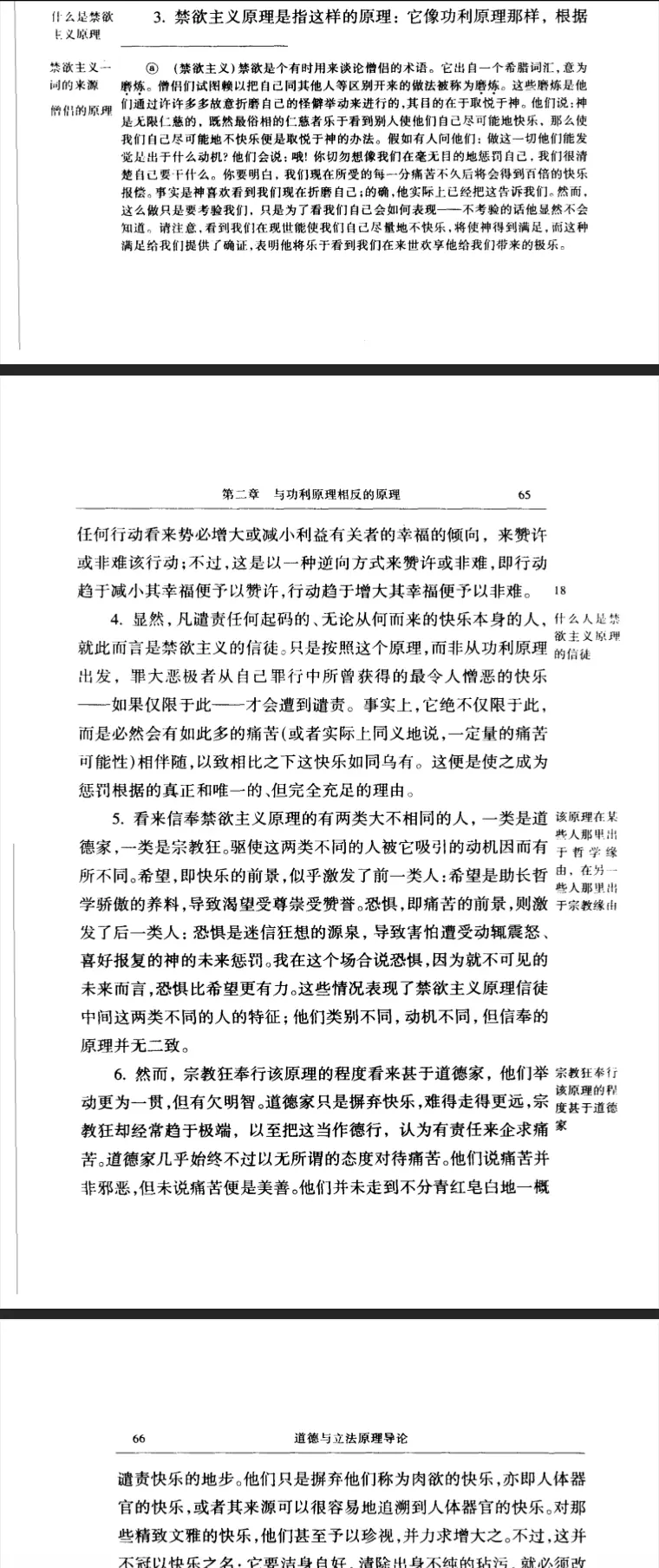
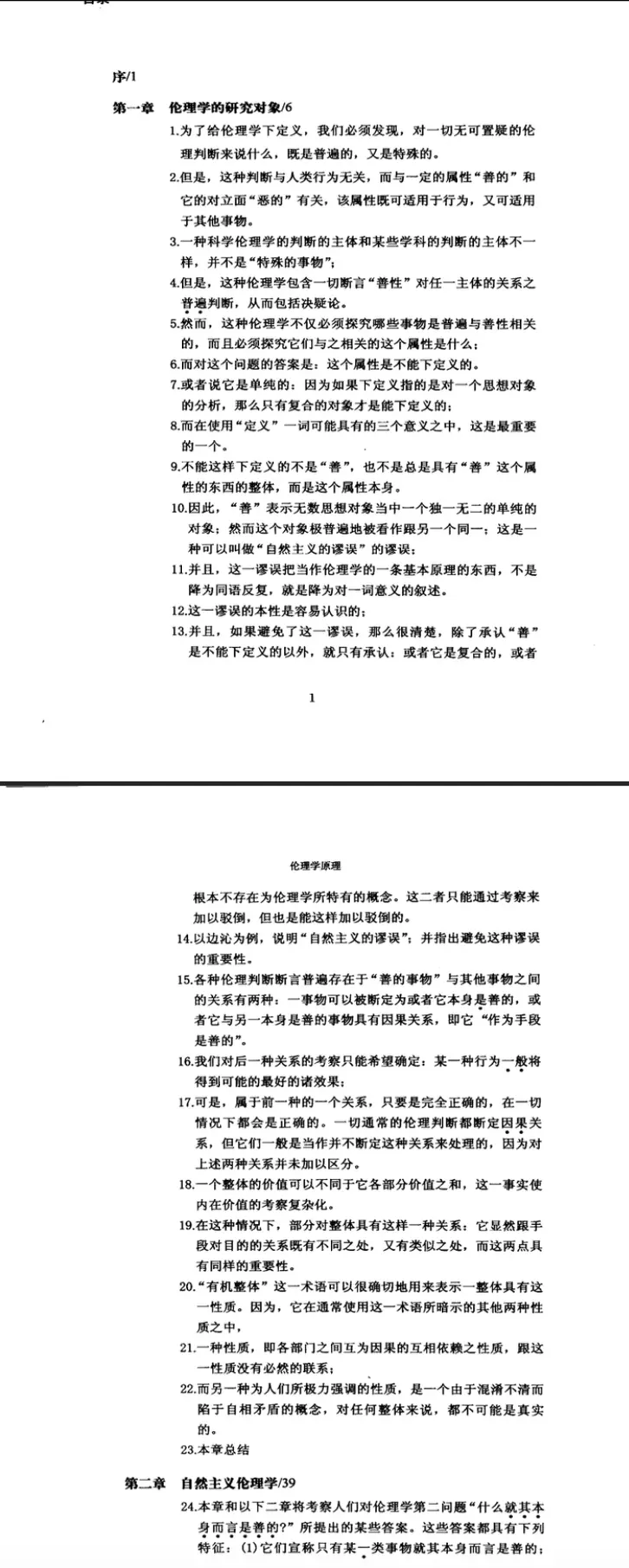
This question gives us a chance to ask about the rationale behind school reading-comprehension methods. Why summarize paragraphs, extract central ideas, and map structure? Because good writing is built on exactly these frameworks. Excellent writers have mature and clear thought; they plan structure carefully. What is the central thesis of this article? What evidence supports it? What does section one or paragraph one do? These are planned in advance. For a book: what are its major theses? How are supporting reasons advanced? How are possible objections preemptively addressed? How is the resulting theory applied? Such things are usually planned before writing. In many works, the table of contents summarizes each paragraph in one or two sentences - meaning that, at least by final revision, the central point and role of every paragraph are clear. Bentham is a typical case. His prose may be dry and cumbersome, but he cared deeply about structural clarity. In the unpublished Of Law in General, the table of contents gives brief summaries for each paragraph. In revising An Introduction to the Principles of Morals and Legislation, he wrote marginal summaries for each paragraph. Many writers did similar things, for each paragraph or at least each subsection, including G.E. Moore.
Many people who received academic training abroad mention one striking habit: teachers keep asking, “What is your thesis?” When writing dissertations, students are warned that without a clear thesis, one should not write at all. What is the core thesis of the article or book? What are the core reasons? How are they organized in composition? These are not allowed to emerge only gradually during writing.
For skilled writers, whether writing a major work or a short fragment, nothing is more important than structure before drafting: what is the problem, how to decompose it, what comes first, what comes later. For skilled writers this is close to instinct.
Great works themselves value structure. That is why they are clear, explicit, comprehensive, and accurate; in short, they can explain issues within the scope of the current text, usually without needing specialized resources outside it. Some historical documents and ancient classics, for various reasons (for example, the Analects is a sayings collection), may lack such deliberate planning. But modern works at least place heavy emphasis on compositional structure. Given this, grasping a text’s core claims, evidence, and structure - and thinking issues as much as possible within that text - becomes the most important principle of modern scholarly reading. Formally, this has no essential difference from school reading comprehension. It is roughly this:
- What does this paragraph mean, and what is its key point?
- What relation does this paragraph have to adjacent paragraphs in argument and composition?
- What are the key points of this section, and how are they connected?
- What are this chapter’s claims and evidence, and how are they developed in specific subsections?
- What relation does this chapter have to nearby chapters in argument and composition?
- What are the book’s main claims and evidence, and how are they developed across chapters?
Only after we use plain methods to clarify the skeleton of a text is it the right time to comment. Understanding is always prior to criticism. Our criticism, at bottom, asks questions like:
- What did the author say?
- What does the author mean by saying it?
- Is it convincing? Which parts persuade me, and where are my doubts?
- If it does not persuade me, why exactly?
- Do I have better claims and evidence than the author?
- Beyond what the current text shows, are there other resources that can be cited and consulted for the author’s claims and evidence?
The first goal of reading is understanding, not criticism, and certainly not mere impression. Try to solve problems within the current text. Concretely:
If the current text does not cite some other authors or works on an issue (or there is no evidence of hidden citation), then we, like the author, should refrain from mentioning them.
If an issue is not discussed in the current text (or there is no evidence that the author is implicitly engaging it), then for this text, it is temporarily irrelevant to both us and the author.
If we find the current text explicitly cites (or likely implicitly cites) some authors or works, but only as brief citation cues, then generally we need not focus discussion on those cited materials, because the author’s composition indicates that, for this text’s purpose, rough understanding is sufficient.
Only when, under the previous condition, we cannot reach smooth understanding without focusing on cited authors or works should we consider expanded discussion.
Reading this way has two basic benefits: first, identifying texts whose claims are unclear and arguments insufficient; second, grasping claims and arguments comprehensively and accurately. For the first point, texts that posture mysteriously can be judged low-quality by this method regardless of how brilliant certain passages seem, because their claims are unclear and arguments underdeveloped. For the second, only on this basis can we remember a text over the long term and understand its views deeply and comprehensively.
Correspondingly, the key goal of notes is to summarize thesis and argument and map compositional structure, rather than extract quotations and famous lines. If most notes are only quote collections, then obviously this lazy and foolish method is useless for academic thinking and writing. Scholarly activity built on highlighting and resonance-seeking, however grand it appears, is fundamentally meaningless for scholarship.