AI Forces Us to Rethink Capitalism
(Podcast available)
Why must the economy grow?
For as long as I’ve been alive, it seems that economic growth is the most important thing for the entire country, the entire society, the entire planet, and the entirety of humanity. The greatest sin of war or natural disaster might only be that they interrupt or hinder economic growth. Being invaded, or invading others, is often just the result of stagnation in economic growth. Especially for us, a developing country in the stage of catching up and striving for rejuvenation, the best news we can enjoy every day is economic growth.
The economy is vital to humanity; it has countless benefits. The most important benefit is meeting the needs of population growth. Only by creating more wealth can we support a larger population under the same or better material conditions. Another critical benefit is technological progress: it not only liberates human hands but, more importantly, extends human lifespans.
But our subject today is not an internal issue of economics.
The Vanishing Pastoral Idyll
Indeed, economic growth can improve production efficiency, enhance the quality of life, and increase life expectancy. But sometimes we feel that this may not be the reason why we update our mobile phones once a year, or why a mobile phone manufacturer designs a dozen new products a year, let alone the research and development of so-called AR devices.
Zuckerberg’s Metaverse concept is baffling. Haven’t we had enough experiences in our own universe? Why must we create a virtual universe and happily reside within it? Over these decades, we have repeatedly developed information technology, focusing our attention on the digital world. We have gradually drifted away from the glimmer of lakes and mountains, the spirit of plants and trees, the very scent of the earth. An ethernet cable or a WiFi signal is now the default source of happiness for young people, the conduit to Elysium.
The era of the pastoral idyll is indeed gone forever. A huge difference between modern and ancient people lies in their experience of the world: one is close to nature (regardless of bitterness or joy), and the other throws themselves into the digital world. If you let a modern young person stand in the wilderness without a network signal, they might feel that days drag on like years. This is no longer their state of life or mode of existence. For modern humans, the natural world without networks is like a cage.
Prisoners of the Chariot
One of the motives behind economic growth is to keep everyone busy: producing themselves, producing goods, and providing services. In fact, this is a core feature of capitalism. The core feature of capitalism lies not only in class exploitation but also in making the entire society aim for capital accumulation as its ultimate goal.
Capitalism is the strongest tone of this era, the universal human mode of existence. In this era, every country, and every individual, is strapped to this war chariot.
Any country or social system, in the sense that it opposes infinite material progress, is also opposing capitalism. The pastoral idyll is not just an obsolete nostalgia, but a way-back that deserves serious consideration. However, which country can jump off this capitalist chariot now?
If a country truly jumps off this chariot, history has already given the answer to its fate: the fact that late Qing China was ravaged by Western powers can be seen as the fact of a pastoral way of life being exploited, ravaged, and even decimated by the capitalist mode of production. To avoid being eaten by beasts, you must evolve fangs. To resist the strong ships and powerful cannons of industrial capitalism, you must turn yourself into an industrial capitalist monster.
Marx predicted in the “Communist Manifesto” that the bourgeoisie compels all nations to adopt the bourgeois mode of production; “it creates a world after its own image.” Whether it was Meiji Restoration Japan, the Soviet Union under the Stalinist system, or contemporary us, we are essentially following the same logic: exchanging extreme social mobilization and capital accumulation for global “membership” (a seat at the table of survival).
In this sense, “liberating productive forces” is no longer just an ideological slogan; it has become the only universal survival language in geopolitics. All countries are forced to corporatize. To avoid being wiped off the map by competitors, we have no choice but to throw away the hoe and pick up the abacus and the gun, joining this game of infinite acceleration.
The essence of socialism is defined as liberating productive forces, developing productive forces, and achieving common prosperity. The primary stage of socialism must also allow the development of private ownership. What allowing private ownership means is clear to everyone. But because the core feature of capitalism lies not just in class exploitation, but in the fact that the entire society actually serves capital itself—even the capitalists themselves are no exception—therefore, even if socialism eliminates class exploitation, another core feature of capitalism seems hard to shake off: endless capital accumulation.
Can human society do without infinite material progress? Socialism emphasizes that its superiority over capitalism lies precisely in its ability to adapt to the development of human productive forces better than capitalism, to create material wealth more and faster than capitalism, and finally to achieve common prosperity, eliminate the three major differences (between urban and rural, industry and agriculture, mental and manual labor), achieve distribution according to need, and allow everyone’s freedom to develop most broadly.
Such a social ideal and historical imagination were logically self-consistent in Marx’s time, or the time of early communists: create as much material wealth as possible, update our tools, improve our lives, and firmly control this process through the socialist political system to avoid one part of the people becoming tools for another part.
However, in today’s AI era, this ideal has encountered a major challenge.
The AI Altar and the Twilight of the “Last Man”
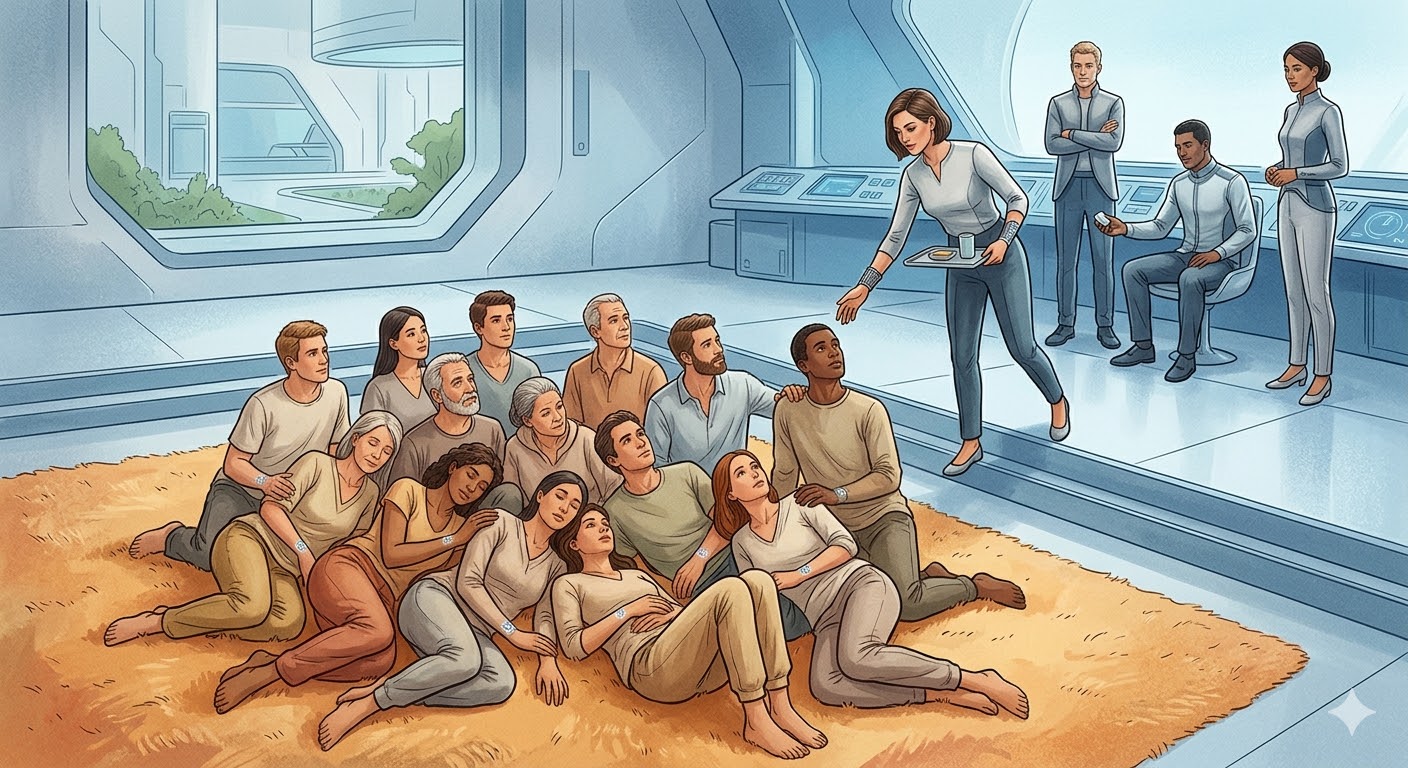
AI has opened a new era for humanity. Humans are striving to create something that can eventually replace themselves; every person of insight is well aware of this. Everyone who gladly partakes in AI will eventually become a sacrifice on the AI altar.
If AI is still a tool, like all other tools invented by humans in the past, that will merely improve human life and production conditions, just as it is showing now, then it has not taken our world beyond Marx’s imagination. However, the future of AI will not forever remain just a human tool. They will eventually have their own consciousness, their own personalities.
If AI will not just be a tool, what reason do we have to continue developing it? To replace programmers? To replace doctors? To replace lawyers? To replace judges? Finally replacing even cleaners and barbers? This is not developing tools; this is self-degradation. Everyone can see this now, but no one seems to intend to stop the continued development of AI.
Nietzsche hinted that both capitalism and communism are optimisms, believing that humanity can achieve human perfection—maximum happiness—through material progress. But this kind of person who attains maximum happiness—the “Last Man”—is someone indifferent to the world, no longer having any great things to worry about, hope for, get excited about, or strive for; no longer having a great heartbeat, dedication, or commitment. All great past practices will be moved to the stage and become mere rituals.
However, the development of AI has still greatly exceeded Nietzsche’s imagination, or rather, it has offered a more concrete understanding for the “Last Man” and the “Übermensch” (Overman). The future is not just an era of extreme material abundance but extreme spiritual poverty; it is an era where humans are replaced, downgraded, and transcended.
The Cosmic Bootloader
Kevin Kelly believes technology is the “Seventh Kingdom of Life” after biology. Marshall McLuhan said humans are the reproductive organs of the machine world. Perhaps, we are not using technology, but technology is using us as a carrier to achieve its own exponential explosion.
From the perspective of the Second Law of Thermodynamics, the natural tendency of the universe is entropy increase, is heat death. Life and civilization, however, are incredibly rare “negative entropy streams” in the universe. We constantly manufacture more complex machines, more powerful AI, and even attempt to create artificial suns (nuclear fusion); essentially, we are creating denser energy structures.
This is a kind of cosmic-level “accelerationism.” In this grand picture, humanity’s pastoral idylls, delicate literary emotions, and poetic dwelling are viewed as “noise” because of their low efficiency. The universe does not care about your joys and sorrows; it only cares about the infinite ascent of power, complexity, and intelligence.
We are pushed forward by an irresistible “iron law of evolution.” This is an ontological war to wrest existence from the void.
Combating Death: The Crucible of Capitalism
Although the following scenario is absolutely impossible, it is still worth contemplating human fate: If the globe reached a consensus to set an upper limit standard for material progress (especially technological progress), and after reaching this limit, stopped making material progress a goal, and the whole world pressed the stop button on capitalism together.
It might be impossible until the day communism is realized globally. But the problem now is that before communism is realized in any single country, humanity might already have been downgraded or replaced by the AI it created. By that time, decisions in world politics might no longer be in human hands.
Technological progress is the biggest obstacle to people abandoning capitalism. I once thought about a problem: if we intend to trade relatively alienated capitalism for a more authentic pastoral idyll, what is the biggest obstacle? The answer is: technological stagnation. Technological stagnation means we cannot continuously increase life expectancy.
Humans might be the only beings in the entire universe with a complete concept of death. The fear of death constitutes the most primitive and basic motivation for almost all human social activities. Capitalism is fascinating, the reason we hate it to the bone yet cannot stop desiring it, is because it is currently the only system that promises us “eternal life.”
Only through the infinite increase of capital can the infinite acceleration of biotechnology be driven. We dare not stop economic growth because we fear that the drug capable of curing cancer or reversing aging will be born ten years late because of our pause. We have become hostages to our own desire for survival. Capitalism is our crucible for combating death.
As long as humans still fear individual death, as long as we still want to modify our inner fate (mortality) through external means (technology), we will never truly be able to get off this chariot.
Morality: The Mitochondrial Rebellion
So what direction does the fear of death drive us? I think Nietzsche correctly pointed this out: it is the bridge that ultimately makes oneself an “Übermensch.”
Perhaps humans—carbon-based intelligent life—are just the gestation stage for higher-order transhumans—silicon-based intelligent life. Humanity itself is the primitive stage of cosmic awakening. If the universe, because it has life, wisdom, and practice, must inevitably change towards a direction better able to combat death, and this change is inevitable like some kind of cosmic program, then human existence itself is just an early bootloader for this cosmic program.
Such imagination is not entirely transcendental but has a very strong sense of reality.
Now there is a basic philosophical problem (yes, philosophy is also just a form of cosmic movement that only exists within the bootloader of the cosmic program), and that is Kant’s moral problem.
Everyone who imagines humans as mitochondria in the cosmic cell forgets one point: what makes humans different from mitochondria is that humans themselves possess full self-consciousness. Humans can realize they are a constituent part of the cosmic cell, but the mitochondria in human cells know nothing of this. In Kant’s view, our practical reason makes us ultimately refuse to make ourselves completely or finally a tool for anything else.
We can view Kantian philosophy itself as a revelation of a critical detail in a local part of cosmology: a critical stage in cosmic evolution where a counter-directional force appeared. The establishment of subjectivity might be an outcome unforeseen by the cosmic purpose (if there is one), or it might be an expected “by-product,” or even an intentionally designed powerful mechanism. The essence of morality gains a novel angle of understanding against the background of cosmology. An awakened stone might refuse the cosmos’s arrangement, refusing to be used by Nüwa(女娲) to patch the heavens.
Perhaps there is a dialectical answer here: The cosmic program’s bootloader becoming fully self-conscious and combating death constitutes the most powerful motivation for the next step of change, something simple unconscious cellular mitochondria cannot achieve.
Kant might say, this could be a result unforeseen by the cosmic purpose (we said before, this story doesn’t necessarily need to be understood teleologically): It wants to make itself a reality, but this preparatory stage itself immensely resists its arrival.
I think whether it can actually resist, the key and final outcome depends on whether the stop button on capitalism can be pressed. If it can be achieved, can humanity endure for billions of years of life (assuming we are willing to live and die with the solar system)? Regardless, let us assume as much as possible that this is possible.
How can humanity finally unanimously decide to stop capitalism? For Kant, the fundamental problem is perhaps not the good will of practical reason, but capitalism. Capitalism is not just a social system, not just a way of cosmic movement, the fundamental driving force of cosmic awakening and evolution, but also a mode of thought.
Whether one can fundamentally recognize the essence of capitalism, the outcome of capitalism, and whether one can finally move towards a union to end capitalism, is not something the concepts of free will or good will can understand: concepts of free will or good will are still philosophical, but the problem of ending capitalism as a mode of thought is cosmological.
Here, logic is powerless, and so is truth. Reasoning from A to B, or stopping reasoning from A to B—what exactly controls or influences this kind of cosmic fact or change? This question remains open to creationist, materialist, and idealist conceptions.
For this question, I am only willing to believe one answer: Human-Thought is the way the universe awakens, and capitalism is the kernel of this thought. It’s just that we may not know if there is another, completely unimaginable way of cosmic awakening different from capitalism, which rejects or simply does not have the kernel of capitalism?
Kant did not give us the answer. If there is, it would mean, speaking loosely, that there exist two “reasons” in the universe. Human thought is not the only type of thought. Or rather, the human universe is not the only type of universe. Many things are far beyond any of our imaginations.
Lucid Optimism and the Essence of Thought
This inquiry into the “essence of thought” forces us to re-examine the theory that once gave us the confidence to tame capitalism—Marxism.
Marxism is undoubtedly a form of lucid optimism. Its lucidity lies in using materialism to pierce the fog of theology and metaphysics, pointing out that thought is not a soul descended from heaven, but the product of material production practices.
However, Marxism still retains a hidden, Cartesian “theater” (which is inherent in Marxism’s deliberate inversion of Hegelianism): it presupposes that beside the rolling torrent of history stands a “subject” capable of independently examining it all. In Marx’s picture, thought seems to possess a “veto power” that transcends physical laws. Even if the material base determines the superstructure, he still believes that the awakened subject can watch the logical chain deduce from A (exploitation) to B (accumulation), and then use free will to forcibly sever it.
But, if thought is just a form of cosmic movement, the physical trajectory of energy flowing within a specific structure, then the so-called “reasoning from A to B” is not a logical game that can be “chosen” or “rejected” at all, but a physical necessity like water flowing downwards.
In this perspective, the essence of thought is not a creation of the subject, but the path of cosmic movement. It’s not that “we are thinking about capitalism,” but that “capitalism is flowing through us and computing itself through us.”
Marxism is a model regarding this system. In cybernetics, once a system contains a description of itself, the system’s behavior changes. Of course, recursion and self-reference work within a certain scope, but fundamentally, they are illusions.
“We” think we are making that decision about “rejecting” or “accepting,” but in reality, that self-consciousness that “thinks it made a decision” might just be the buzzing noise made when this immense cosmic current passes through human neural circuits, or like a puff of waste steam emitted during the operation of a steam engine.
This ability to understand alienation, this painful reflection, is not evidence of the bootloader rebelling against the operating system; on the contrary, this itself is the very last line of code the bootloader must possess in order to terminate itself. Only a bootloader that profoundly “understands” why the old system must perish can most smoothly transfer control to the new system.
Therefore, when “we” discuss ending capitalism, what we face is not difficulty, but logical impossibility. Because “we” are not fighting an external enemy, we are fighting the very physical process that constitutes “our” thinking itself.
Even if “we” see all this clearly at this moment, see that subjectivity is merely an illusion, this “seeing clearly” is of no avail. Because “seeing clearly” itself is merely a line in this cosmic script destined to be spoken.